4

Authority builder- Conversion truths

Why isn't more traffic gonna save your business?

In today’s fast growing digital landscape, most businesses think the best way to expand and grow is to increase the traffic. The most natural reactions to lack of leads from an entrepreneur would be to start running Ads, spending money on SEO or doing better marketing. Although traffic is crucial, it is not exactly what a business necessarily needs.

The truth is simple,higher traffic is not going to fix a broken system. Thousands of visitors are not gonna turn into long term customers if your website isn’t harmonized. If your hook is not providing value you are going to immediately lose a customer, similarly unclear messages, vague offers and poor website structure all have the same effect.

This is what most businesses do, instead of fixing their foundation they keep on investing on instant visibility which in turn costs them major opportunities.

Conversion is the true issue, Not Traffic

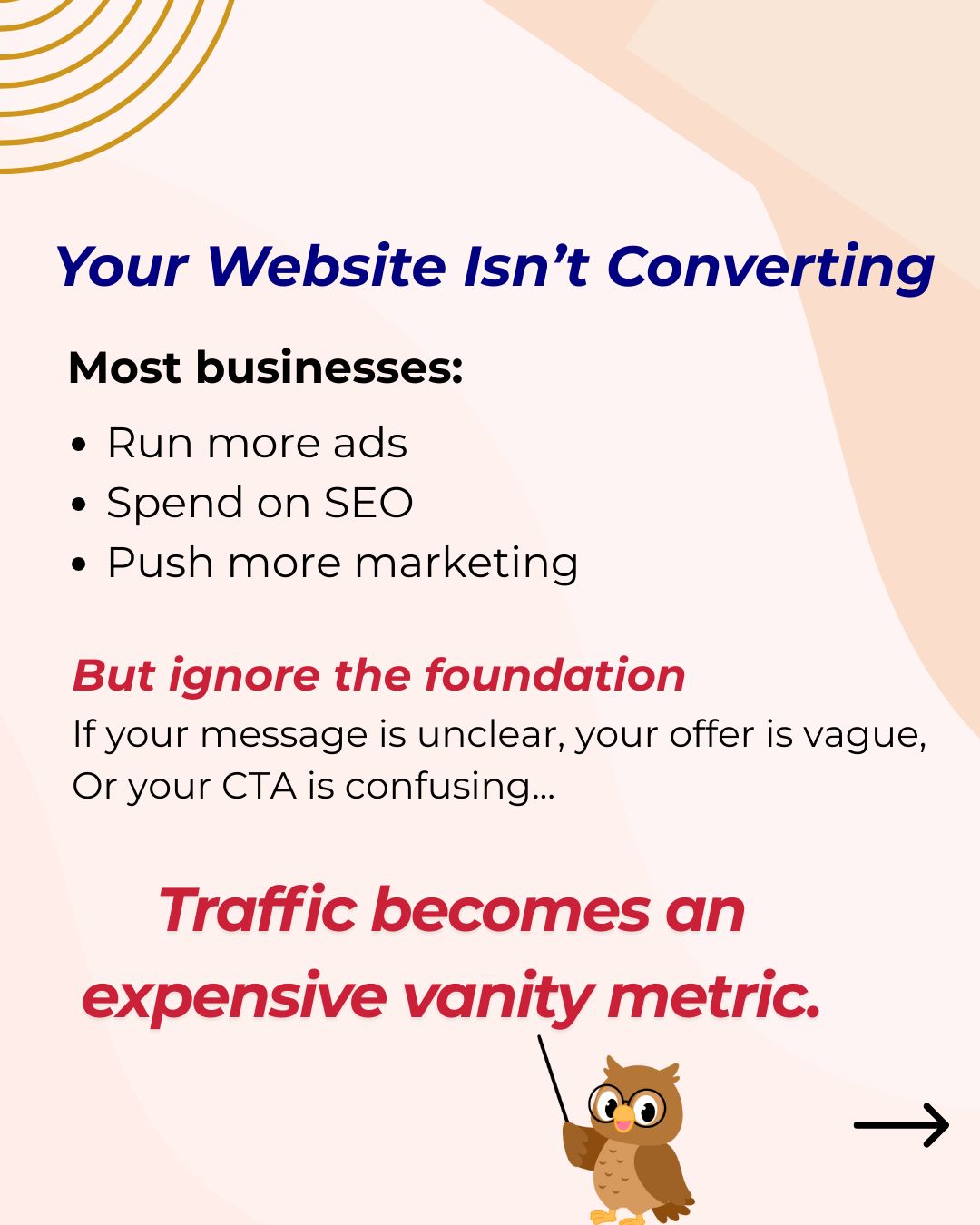
Businesses need to understand that increased traffic doesn’t actually mean increased revenue. Without conversion, Traffic is just an expensive vanity metric.

Recently more than 30 company websites from different industries were reviewed. Surprisingly, all of them had good traffic ratios but their websites were unable to convert that traffic. Most of those websites had the same fundamental problem. We will be discussing these common problems which entrepreneurs think are not so common in detail.

Most common Conversion killers

Weak and confusing Headlines:

Headline is the first thing people read about your company. Within the first few seconds of the visit the fate is decided by the visitor whether he wants to stay or leave the page. Unclear, excessively generic and vague headlines are going to turn into lost customers. A strong headline should clearly communicate:

  • What the customer needs?
  • How can you help ?
  • Why is it important?

Sometimes you have to help the customer identify the problem and help them solve it, and your headline should make the customer think that they are at the right place. Remember, clarity is more important than creativity when it comes to conversions.

Unclear CTA:

Unclear call to action means lack of clarity in terms of guiding the visitor. If your website’s effectiveness captures the attention of the user, that’s a good start. The real question is does the user know what to do next. If your website is not guiding the user towards an action, whether it is booking a call, signing up or requesting a quote it is creating friction and friction always kills conversions.
If you want your website to have a high conversion rate you have to remove uncertainty. Telling the user what to do next and how to do will make them an easy conversion instead of a wasted opportunity.

Lack of testimonials:

Building trust is the ultimate foundation of doing business and testimonials are the currency of trust in case of online businesses. Without proof of work, the best headlines and CTA’s will fail.

One of the largest gaps found in the industrial research was lack of proof of work and testimonials. When users do not see client success stories on the front page they hesitate to invest in becoming a client themselves which ultimately turns into lost leads.

Some basic additions like:

  • Customer endorsements
  • Reviews
  • Before and After
  • Case studies

Can dramatically increase the trust level of the user which will significantly boost the conversion rates.

Slow loading speed:

In today’s fast paced digital world, speed is the basic necessity of a website. Dead speed websites can make the user leave before they even see your offer. Research shows that even a one sec delay can drastically affect the conversion rates of the website. A well optimized fast paced website not only improves user experience but also boosts engagement and trust.

What happens when you fix basics

The surprising fact is that you can completely change the performance of your website by fixing just the basics, thus there is no need to spend a fortune on massive marketing and a full redesign.

According to the research, companies who invested in improving the basic functionality of their websites saw an average boost of 28% in leads. And this increase came from improving and managing the already existing functionalities, not from bringing new traffic.

Concisely, keeping the base optimised, making impactful first impressions and Keeping CTA clear will ultimately get you massive growth. And businesses mostly get this backwards.They chase traffic and visitors because more traffic feels exciting, it feels like progress but if your conversion rate is not higher than your clicks then you are doing it all wrong.

The right way

Businesses need to understand that growth doesn’t come with traffic alone. It needs alignment, optimization and harmonized core aspects of the website. The three core areas where businesses should work to improve rates are:

Fix your message:

Having a clear and concise message for the user which should include the problem identification, how it is affecting the user and how you can solve it is very crucial. It will make the user understand instantly about what you do and why it matters which will ultimately increase trust. Your message should simply be customer focused.

Fix your offer

A strong offer is the value your business is providing to the customer. Clearly mentioning the strategies applied and tactics used in your work.

Fixing the message is improving your way of communicating your work and offer is the work.

Fix your Funnel

Lastly, fixing the funnel is the integral part of improving the website. As the importance of CTA was explained, your funnel should clearly communicate the user from interest to action. From the landing page to the CTA everything should be concisely clear and easy to understand.

How we help businesses bridge the gap

We think that growth is more about doing the right things in the right order than doing more than what’s needed. Fixing what’s needed, improving the basics and then following a strategy.

We prioritise the digital foundation and needs of the business instead of pushing them into aggressive scaling or rapid advertisements. Because most of the time businesses invest everything but execution of a strategy.

Summary:

Traffic alone does not guarantee conversion and sales at all. Turning a visitor into a high end client does. If the consumers are not directly intended towards a clear CTA, even an extremely aesthetically pleasing website will fail. Clarity and guidance are crucial in this case. An attention grabbing headline, a clear call to action and an experience that naturally encourages the conversations is all that is needed. Without these no matter how much traffic a website gets, potential leads will keep on slipping.

Understanding the user behavior, simplifying the decision making processes for the user and creating a smooth journey from interest to action is very crucial. Users will more comfortably invest in business with clear offers, social proofs and expert positioning. Turning the attention to action should be the ultimate goal.

IT Consultancy Near me

Why IT Consultancy is Essential for Your Business Growth

Introduction

Unlock Your Business Potential

Lets take a moment to reflect on your business’s IT infrastructure. Are you optimizing technology for growth, protecting sensitive data from cyber threats, and staying ahead of the digital curve? If you’re struggling to answer these questions, you’re not alone.

Discover the Power of IT Consultancy

Expert guidance can revolutionize your technology infrastructure, ensuring seamless operations and fuelling innovation. A well-chosen IT consultancy optimizes operations, protects against cyber threats, future-proofs your infrastructure, and unlocks new revenue streams through technology.

Types of IT Consultancy Services

IT consultancy encompasses various services, tailored to suit different groups:

  • IT Strategy Development:

 Ideal for startups, small businesses, and entrepreneurs seeking guidance on technology infrastructure.

  • System Integration and Implementation:

Suitable for medium-sized businesses looking to streamline operations.

  • Cybersecurity and Risk Management:

Essential for large enterprises, e-commerce, and financial institutions requiring robust security.

  • Cloud Computing and Migration:

 Beneficial for businesses seeking scalability and flexibility.

  • Data Analytics and Management:

 Ideal for data-driven organizations seeking insights.

With these services in mind, let’s examine the benefits of partnering with an IT consultancy.

Benefits of IT Consultancy

Partnering with an IT consultancy offers numerous benefits:

  • Expertise:

Access specialized knowledge and skills.

  • Objectivity:

 Gain unbiased perspectives on technology decisions.

  • Efficiency:

 Streamline operations and reduce costs.

  • Innovation:

 Stay ahead of the technology curve.

  • Risk Management:

 Mitigate cybersecurity threats and compliance risks.

To illustrate these benefits, consider the following real-world example.

Real-World Example:

Microsoft partnered with Accenture to implement a cloud-based ERP system, resulting in:

  1. 30% increase in productivity
  2. 25% reduction in costs
  3. Enhanced data security

This success story highlights the tangible results of IT consultancy. Now, let’s explore how local IT consultancy can provide personalized solutions for your business.

Benefits of Local IT Consultancy

Now that we’ve explored the benefits of IT consultancy, let’s dive deeper into the advantages of local IT consultancy.

Local IT consultancy offers targeted solutions, addressing unique regional challenges. By partnering with a local IT consultancy, you’ll enjoy personalized support from experts familiar with your market. This direct access ensures quick issue resolution, minimizing downtime.

Building on this personalized approach, local IT consultancies provide customized solutions tailored to your business needs and local regulations. This targeted approach often proves more cost-effective than partnering with national or international consultancies.

Furthermore, local IT consultancy fosters community involvement, supporting local businesses and economic growth. Regional expertise is another significant advantage, providing an in-depth understanding of local market trends. Enhanced collaboration is further facilitated through face-to-face interactions, ensuring seamless communication.

To illustrate these benefits, consider the following real-world example. Dell partnered with local IT consultancy, Tech Solutions, to enhance their regional operations. Results included a 40% increase in regional sales, 30% reduction in operational costs, and improved customer satisfaction.

With these advantages in mind, let’s move on to selecting the right local IT consultancy for your business.

Choosing the Right IT Consultancy

When selecting an IT consultancy, consider the following crucial factors:

  1. Firstly, assess their expertise and experience in your industry. Ensure they possess the necessary skills to address your specific challenges.
  2. Next, evaluate their reputation and track record. Request case studies, testimonials, and references to gauge their success.
  3. Additionally, consider their scalability and flexibility. Choose a consultancy that can adapt to your growing needs.
  4. Finally, ensure their communication style aligns with yours. Clear communication is crucial for successful project execution.

To further ensure a successful partnership, consider the following essential questions: 

  1. What services do they offer?
  2. What is their experience with similar projects?
  3. How do they approach problem-solving?
  4. What are their availability and response times?

By asking these questions, you’ll gain valuable insights into the consultancy’s capabilities.

For instance, a well-crafted inquiry process helped ABAC Corporation find the ideal consultancy, yielding remarkable results:

  • 99% project success rate
  • 25% reduction in IT costs
  • Enhanced system efficiency

With these guidelines, you’ll find the perfect IT consultancy for your business

Now, let’s move on to implementing IT consultancy services effectively.

Implementing IT Consultancy

After selecting the right IT consultancy, successful implementation is crucial. Ensure a smooth transition by:

  1. Establishing clear objectives and expectations.
  2. Defining project scope and timelines.
  3. Assigning a dedicated project manager.
  4. Fostering open communication channels.
  5. Regularly monitoring progress and addressing concerns.
  6. To guarantee seamless integration, consider the following best practices:
  7. Conduct thorough stakeholder analysis.
  8. Develop comprehensive training programs.
  9. Implement change management strategies.
  10. Establish metrics for measuring success.

By embracing these implementation strategies, you’ll maximize the benefits of IT consultancy.

Real-world applications demonstrate the effectiveness of these strategies. For example:

Microsoft successfully implemented IT consultancy services, resulting in:

  • 30% increase in operational efficiency
  • 25% reduction in costs
  • Enhanced customer satisfaction

Now that we’ve explored implementation, let’s examine the importance of ongoing evaluation and improvement.

Unlocking The Full Potential of IT Consultancy and Implementations Strategies

You’ve found the perfect IT consultancy – now it’s time to bring your vision to life. Effective implementation is crucial to harnessing the full potential of IT consultancy. In this section, we’ll explore the essential steps to ensure a seamless transition.

Step 1: Establish Clear Objectives and Expectations

To establish clear objectives and expectations, define your project goals, key performance indicators (KPIs), and desired outcomes, ensuring alignment with your business strategy.

  • Identify stakeholders and their roles to ensure everyone is on the same page.
  • Determine project scope and timelines to establish a clear direction.
  • Develop a shared understanding of success criteria to measure progress.

Step 2: Define Project Scope and Timelines

  • Outline specific tasks, milestones, and deadlines by creating a detailed project schedule.
  • Establish key milestones and check-in points to track progress.
  • Allocate necessary resources to ensure successful project delivery.

Step 3: Assign a Dedicated Project Manager

  • Appoint a single point of contact to oversee the project, ensuring they have the necessary expertise.
  • Define the project manager’s responsibilities and authority.
  • Establish open communication channels to facilitate collaboration.

Step 4: Foster Open Communication Channels

  • Encourage collaboration and transparency by scheduling regular team meetings.
  • Implement project management tools to streamline communication.
  • Define communication protocols to avoid misunderstandings.

Step 5: Monitor Progress and Address Concerns

  • Track project performance and address issues promptly by establishing regular progress updates.
  • Identify and mitigate potential risks to minimize disruption.
  • Conduct retrospectives for continuous improvement.

Evaluating and improving IT Consultancy

Effective evaluation and improvement of IT consultancy services are crucial for long-term success. Regular assessments ensure alignment with business objectives and identify areas for enhancement.

Key Evaluation Metrics:

To accurately assess IT consultancy performance, consider the following key evaluation metrics:

  • Measure return on investment (ROI) to evaluate financial benefits, as seen in Accenture’s 2020 report, which showed a 25% ROI increase.
  • Track customer satisfaction to gauge service quality, such as Microsoft’s 90% customer satisfaction rate, demonstrating exceptional customer service.
  • Evaluate operational efficiency to identify areas for improvement, like IBM’s 30% reduction in operational costs through process automation.
  • Assess risk management to ensure mitigation strategies, as demonstrated by Deloitte’s 20% reduction in risk exposure through proactive risk assessments.

Step 1: Establish Evaluation Criteria

Define clear evaluation criteria that align with your business objectives to ensure effective assessment.

  1. Identify key performance indicators (KPIs) that accurately measure success, such as revenue growth or customer acquisition.
  2. Develop evaluation tools, such as surveys or assessments, to gather feedback from stakeholders and customers.

Step 2: Conduct Regular Evaluations

Schedule regular evaluations to monitor progress and identify areas for improvement, ensuring timely adjustments.

  1. Gather feedback from stakeholders and customers to understand their perspectives and concerns.
  2. Analyse data to identify trends and areas for enhancement, informing strategic decisions.

Step 3: Implement Improvements

Develop strategies to address identified gaps and weaknesses, ensuring targeted solutions.

  1. Allocate necessary resources for implementation, including budget and personnel.
  2. Monitor progress and adjust strategies as needed to ensure continuous improvement.

Step 4: Continuously Monitor and Refine

Regularly review and refine evaluation criteria to ensure relevance and alignment with business objectives.

  1. Update KPIs to reflect changing business objectives, adapting to shifting priorities.
  2. Ensure ongoing improvement through continuous monitoring and timely adjustments.

Best Practices

Establish a culture of continuous improvement within your organization, fostering innovation.

  • Foster open communication channels to encourage feedback and collaboration.
  • Leverage technology for efficient evaluation and improvement, streamlining processes.

Real-world applications demonstrate the effectiveness of these strategies. For example:

Microsoft implemented regular evaluations, resulting in:

Microsoft increased customer satisfaction by 20% through improved support services.

– The company reduced costs by 15% by optimizing resource allocation.

– Microsoft enhanced operational efficiency through process automation.

SOURCE: MICROSOFT’S 2020 ANNUAL REPORT

IT Consultancy Challenges

Overcoming Common IT Consultancy Challenges

IT consultancy projects can face various challenges that hinder success. Effective problem-solving strategies ensure timely resolution and minimize impact.

Key Challenges

To overcome common challenges, consider the following:

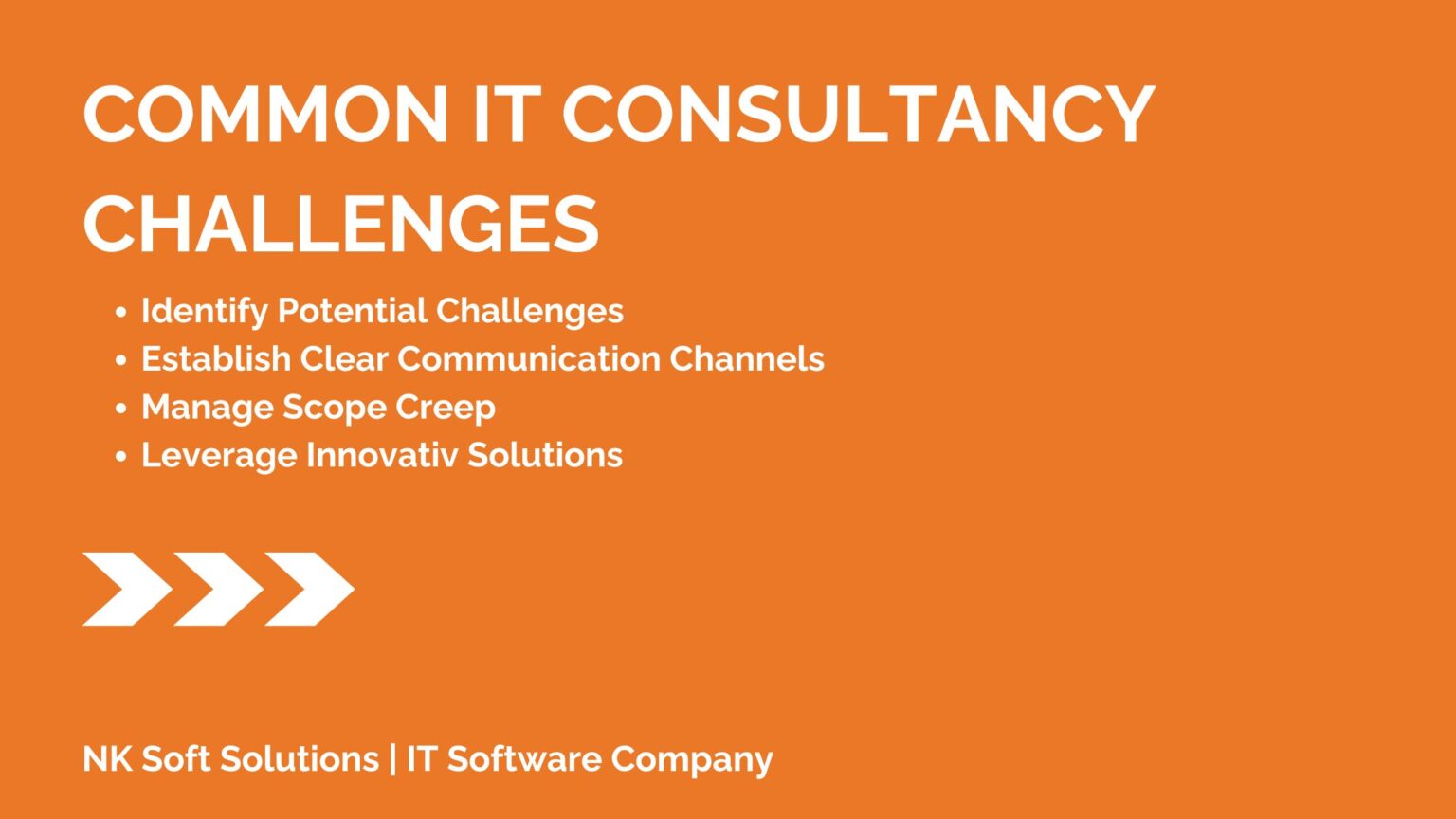
  1. Address communication breakdowns through clear communication channels and regular check-ins.
  2. Manage scope creep by defining project scope and establishing clear expectations.
  3. Overcome technological obstacles through innovative solutions, such as leveraging cloud computing or automation.
  4. Implement effective change management strategies to mitigate resistance to change.

Steps to Overcome Challenges

Step 1: Identify Potential Challenges

  • Recognize potential risks before they become problems to ensure proactive mitigation.
  • Conduct thorough risk assessments to identify potential challenges.
  • Develop backup plans, or contingency plans, to address unexpected issues.

Step 2: Establish Clear Communication Channels

  • Encourage open and honest communication to foster collaboration.
  • Set up regular check-ins to discuss progress and address concerns.
  • Address conflicts quickly to prevent escalation.

Step 3: Manage Scope Creep

  • Clearly define project scope to prevent misunderstandings.
  • Set realistic expectations to ensure alignment with business objectives.
  • Monitor progress closely to identify potential scope creep.

Step 4: Leverage Innovative Solutions

  • Explore new and creative solutions to address complex challenges.
  • Stay updated on industry trends to ensure relevance.
  • Collaborate with experts to leverage specialized knowledge.
Real-world examples demonstrate the effectiveness of these strategies: Deloitte’s approach to overcoming IT consultancy challenges resulted in:
  • 25% reduction in project timelines
  • 30% increase in customer satisfaction
  • Enhanced collaboration and innovation
SOURCE: DELOITTE’S IT CONSULTANCY REPORT

Measuring IT Consultancy Success

Evaluating IT consultancy success requires effective measurement and evaluation. Key performance indicators (KPIs) and metrics ensure alignment with business objectives.

Common KPIs:

1.Return on Investment (ROI):

Measures the financial return on investment in IT consultancy services.

Example: An IT consultancy project costs $100,000 and results in $150,000 in savings. ROI = ($150,000 – $100,000) / $100,000 = 50%

2.Customer Satisfaction (CSAT):

Measures client satisfaction with IT consultancy services.

Example: A survey of 100 clients yields 90 positive responses. CSAT = 90%

3. Project Timeline Reduction:

Measures the reduction in project timelines.

Example: An IT consultancy project is completed 20% faster than expected. Timeline reduction = 20%

4.Cost Savings:

Measures the reduction in costs.

Example: An IT consultancy project results in $50,000 in cost savings. Cost savings = $50,000

5.Increased Efficiency:

Measures the improvement in operational efficiency.

Example: An IT consultancy project streamlines processes, reducing processing time by 30%. Efficiency improvement = 30%

Steps to Measure Success:

Step 1: Define KPIs

Identify relevant KPIs aligned with business objectives.

Establish clear targets and thresholds.

Example: Define ROI target of 30% and CSAT target of 85%.

Step 2: Collect Data

Gather data through surveys, feedback forms, and project metrics.

Ensure data accuracy and reliability.

Example: Conduct quarterly surveys to measure CSAT.

Step 3: Analyse Data

Assess data to identify trends and areas for improvement.

Compare results to established targets.

Example: Analyse project timeline data to identify areas for reduction.

Step 4: Adjust Strategies

Refine strategies based on data analysis.

Implement changes to optimize performance.

Example: Adjust project management approach to reduce timelines.

Real-world examples demonstrate the effectiveness of these strategies:

Accenture’s measurement approach resulted in:

  • 30% increase in ROI
  • 25% improvement in CSAT
  • 20% reduction in project timelines

SOURCE: ACCENTURE’S IT CONSULTANCY REPORT

Effective Communication

Effective communication ensures all stakeholders are informed and aligned throughout the project. This involves regular stakeholder updates through recurring meetings, progress reports, and newsletters. Clear project documentation is also crucial, maintaining detailed records of project scope, timelines, decisions, and changes. Additionally, establish a transparent issue escalation process to address and resolve issues promptly.

To implement effective communication:

  • Develop a communication plan outlining stakeholder engagement, project updates, and issue resolution processes
  • Assign a dedicated communication lead

Utilize collaboration tools like Slack, Trello, or Asana

Project Management

Strong project management ensures timely delivery and quality outcomes. Define project scope and timelines clearly, outlining objectives, deliverables, and deadlines. Set realistic expectations by establishing achievable milestones and timelines. Embrace agile methodologies for iterative development and flexible responsiveness.

To implement effective project management:

  • Conduct thorough project planning and requirement gathering
  • Establish a project management framework (e.g., Waterfall, Agile, Hybrid)
  • Regularly review and adjust project scope and timelines

Continuous Improvement

Continuous improvement ensures adaptability and growth. Conduct regular assessments of project progress and outcomes. Encourage stakeholder feedback and implement changes. Stay updated on emerging technologies and best practices through industry trend monitoring.

To implement continuous improvement:

  • Schedule regular project retrospectives
  • Implement a feedback mechanism (e.g., surveys, workshops)
  • Attend industry conferences and workshops

Collaboration and Teamwork

Collaboration fosters innovation and success. Assemble cross-functional teams with diverse skill sets. Involve stakeholders in decision-making processes and leverage subject matter expert knowledge.

To implement effective collaboration:

  • Establish clear roles and responsibilities
  • Foster open communication channels
  • Invite subject matter experts to contribute

Risk Management

Proactive risk management ensures resilience. Anticipate potential risks and develop mitigation strategies. Prepare for unexpected events through contingency planning.

To implement effective risk management:

  • Conduct risk assessments
  • Develop a risk management plan
  • Regularly review and update the plan

Technology Expertise

Staying current with technology ensures relevance. Monitor emerging technologies and apply relevant innovations. Maintain a vendor-agnostic approach.

To implement technology expertise:

  • Attend industry conferences
  • Participate in online forums
  • Collaborate with technology experts

Conclusion

Implementing effective IT consultancy services is crucial for businesses to optimize technology infrastructure, drive innovation, and ensure seamless operations. By understanding the types of IT consultancy services, benefits of local consultancy, and best practices for implementation and evaluation, businesses can make informed decisions. Regular assessments, continuous improvement strategies, and effective communication are key to overcoming common challenges and maintaining successful partnerships. By measuring success through key performance indicators, businesses can refine their strategies and achieve significant returns on investment.

In addition to these factors, it is important to consider the evolving landscape of technology and how IT consultancy can help businesses navigate this terrain. With the rapid advancement of digital tools and platforms, organizations must remain agile and adaptable. IT consultants can provide insights into emerging technologies such as artificial intelligence, cloud computing, and cybersecurity measures, allowing businesses to stay competitive.