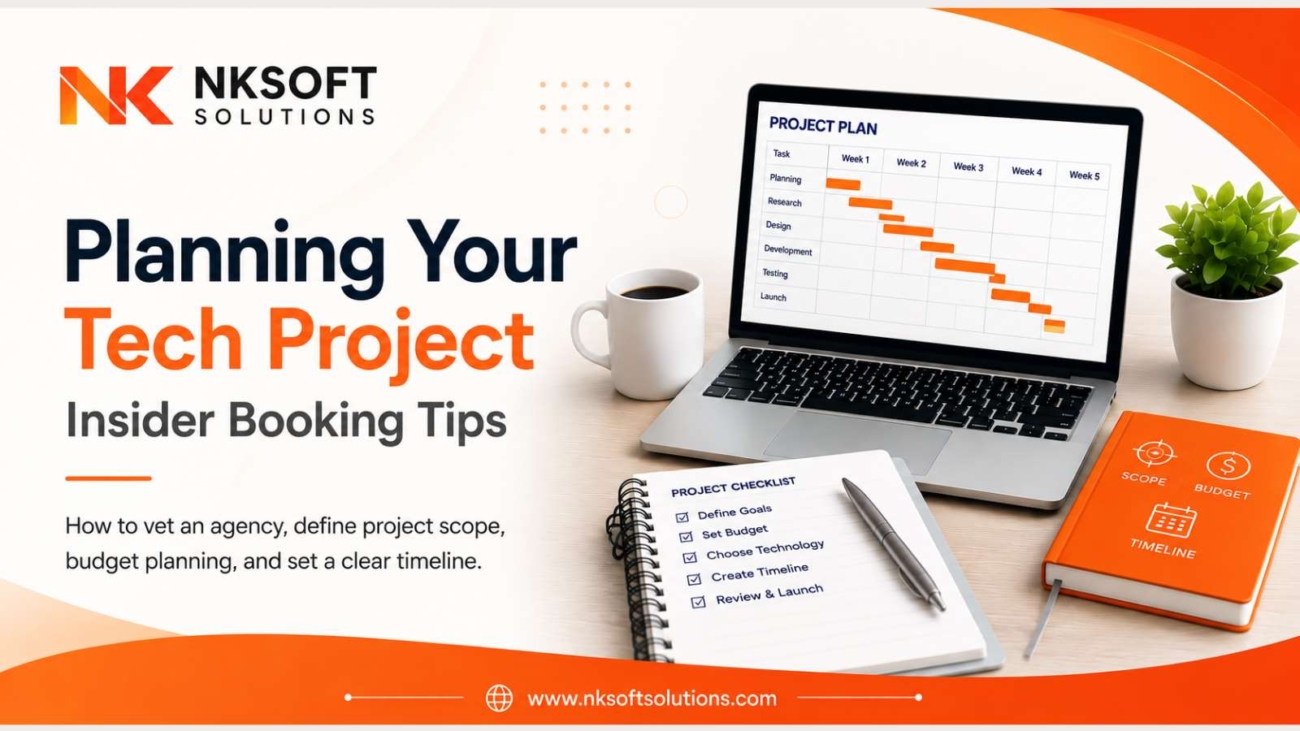

Planning a Tech

Planning a tech project

Launching a digital product without proper planning often leads to missed deadlines, budget overruns, communication gaps, and unsatisfactory results. The success of your product depends on how well you plan before development starts, regardless of whether you are creating a mobile application, Saas platform, e-commerce website, CRM system or custom enterprise software.

Without establishing requirements, comprehending technical viability, or selecting the best technology partner, many companies dive straight into development. For this reason, software development consulting has emerged as a crucial initial step for both startups and large corporations. Businesses may evaluate the ideas, set project goals, assess expenses, identify technical obstacles, and design a realistic development roadmap with the aid of an effective consultation process.

However, employing an IT agency involves more than just choosing the cheapest supplier. Companies want development partners who are knowledgeable about software architecture, UI/UX design, scalability, communication procedures, and long-term product maintenance. Poor code quality, security flaws, delayed launches, and needless operating expenses might result from selecting the incorrect agency.

Businesses may ride on these risks and ensure higher ROI and smoother execution with proper project planning.

How to Vet an agency:

One of the most crucial choices in any digital project is choosing the appropriate development firm. A professional agency offers scalable development solutions, technical know how and strategic insights in addition to writing code.

Assessing technical proficiency:

Businesses should evaluate an agency’s technical capabilities and areas of expertise before choosing one.

Some of the crucial elements are:

  • Familiarity with pertinent technology
  • Understanding of software
  • Scalable architecture
  • UI/US design proficiency
  • Capabilities of front end and back development

User behavior, market demand, and platform expectations can all be better understood by an agency with experience in your particular sector.

Review portfolio and case studies:

Additionally, case studies aid in determining the agency’s capacity to manage projects of comparable complexity and scope:

  • Previous project quality
  • Design consistency
  • Application performance
  • User experience standards

Case studies also help identify whether the agency can handle projects of similar complexity and scale.

Understanding post launch support:

When employing an IT agency, many organizations neglect maintenance and support services. Reputable companies ought to provide:

  • Bug fixes
  • Updates to security
  • Enhancement of performance
  • Scalability assistance

After deployment, long term technical support guarantees that the program stays updated and stable.

Defining project scope:

Confusion, scope creep, and needless development expenses are avoided with a well defined project scope.

Determine your main goals:

Businesses should specify the software’s purpose, target market, objectives and anticipated results prior to starting development. Agencies can create precise technical plans and project roadmaps with the aid of well defined objectives.

Strategically prioritize features:

Businesses should concentrate on an MVP with essential features like user authentication, payment integration, dashboards, and admin controls rather than introducing further features at first. This method expedites deployment while lowering hazards.

Creating detailed requirement documentation:

Development misunderstandings are reduced by appropriate documentation. To increase development speed, requirement documents should precisely describe feature specifications, user processes, API requirements and third party interfaces.

Define scalability requirements:

Future expansion, higher traffic, feature extension and performance optimisation should all be supported by the software design. Businesses can avoid future expensive renovation by using scalable planning.

Budget planning for your tech project:

Understanding cost factors:

Because development costs vary according to project complexity, technology stack, UI/UX requirements and total development hours, budget planning is essential to a successful software development consultation. Because of their complex functionality and scalability needs, enterprise level platforms typically require larger investments than simple websites or smaller digital goods.

Avoid choosing based on lower cost:

Companies should not choose development firms only because of their low prices. Low cost development solutions frequently lead to insufficient security infrastructure, poor code quality, project delivery delays, and costly long term maintenance. Businesses should give priority to technological know how, scalability and long term project value rather than just short term savings.

Planning for continuous optimization:

Even after they are introduced, digital products still need to be improved. Budgets for feature upgrades, performance optimisation, scalability improvements and user feedback implementation should be set aside by businesses. In today’s rapidly changing market, organizations may stay competitive by continuously optimizing their operations.

Setting realistic timelines:

Understanding the development lifecycle:

Professional software development involves multiple stages including consultation, UI/UX design, programming, testing, deployment and post launch maintenance. To guarantee efficient execution and on time delivery, each phase necessitates careful planning, teamwork and resource allocation.

Using agile methods:

Agile approaches, which divide projects into small manageable sprints for increased flexibility and transparency, are used by many organizations. Faster application of input, improved team work, manageable pressure, lower risk and more effective project tracking throughout the development lifecycle are all supported by agile development.

Account for testing and revisions:

To guarantee software performance and stability prior to release, testing and changes are crucial. Easier detection of technical problems and a more seamless final deployment are made possible by functional testing, security analysis, performance testing, and cross-platform compatibility checks.

Conclusion:

To plan a successful digital project, it takes more than just recruiting engineers and beginning development. Companies need to identify the best technology partner, set reasonable budgets, assess technical requirements, and establish clear objectives. Software quality. Scalability and long term economic performance are all directly impacted by these early choices.

In a similar vein hiring a tech agency necessitates a thorough assessment of post launch support, procedures, communication standards and technical knowledge. Rather than ethanol offering services a trustworthy agency should serve as a long term technological partner.

Ultimately, businesses that promote scalable development methods, realistic budgeting, and strategic planning are more likely to accomplish successful product launches, improved user experiences and long term digital growth.

Summary:

The blog emphasizes how crucial it is to plan strategically before beginning any software product project. It describes how companies can identify project objectives, assess technical needs, estimate budgets, and develop scalable development roadmaps with the aid of expert software development consulting. The blog also covers important aspects of hiring tech agencies, such as technical know-how, workflow management, communication procedures, and post launch support capabilities. In order to prevent delays and operational hazards, it also addresses project scope determination, realistic budget allocation, agile development approaches, and schedule management. In general, this highlights that long-term digital growth and effective product launches depend on careful preparation and the right technology partner.

IMG_4990

Value bomb- Quick checklist

A company’s first response when it stops expanding is typically to run more advertisements, publish more content, recruit more staff or raise the budget. Although it seems constructive, most of the time it just puts more stain on an already ineffective system.

Doing more doesn’t lead to more growth, it comes from doing the right thing at the right time.

Most companies are unaware that a lack of effort is rarely a reason behind stagnant growth. It often stems out from a few crucial holes that subtly limits performance across the entire funnel.

The problem is that these gaps are not always evident. They conceal themselves behind activity giving the illusion that everything is working as it should. This is the point at which a straightforward but organized list becomes effective not as a superficial exercise, but as a diagnostic instrument to determine what is genuinely impeding the company.

Clarity before scale:

One of the most common growth blockers is unidentified niche. In order to broaden the customer base, many companies strive to present himself as a one solution to all. But it actually has opposite effect. The impact of messaging weakens when it is overly general. Because it doesn’t address certain issues or speak directly to a specified audience it is unable to meaningfully connect with anyone.

Clarity drives focus and focus creates relevance.

You may gain a thorough understanding of your audience’s problems, expectations and decision making triggers by having a clearly defined niche and this will reflect in every aspect of your marketing whether it is landing pages, ads or sales calls.

Every other endeavor becomes more difficult in the absence of this clarity. Your services seem generic , your content is aimless and ads are difficult to connect with.

The first thing to consider before examining the performance metrics is whether or not we are communicating with the proper audience in the way which truly matters.

The role of the headline:

The first conversion in digital marketing is attention. Whether someone is going to engage with your message or ignore it depends heavily on your headline. However, rather than viewing it as a strategic advantage many companies view it as a formality.

A weak headline often emphasized on what the business does instead of what the customer needs. It focuses on services rather than conveying results.

This small difference has a much larger impact.

The user’s unspoken query: What’s in it for me? Is promptly addressed by a benefit driven headline.

Conversely, a headline that is vague and generic makes the user second guess. Making  a headline sound better is not the goal of improving it. It’s about making it more precise, pertinent and in line with the true desires of the audience.

Trust is the real conversion:

Even if everything is at place, conversion won’t happen without trust. Today’s consumers are more doubtful than ever. Too many options, too many ads and too many inflated claims are shown to them. They therefore rely on what they can trust upon instead of what the brands claim and promise.

Testimonials, client reviews, case studies  and even recognizable brand associations are all examples of proof. It reduces the uncertainty and validates your claims.

It is critical to understand that trust is built through consistency, no single factor can develop it over night. Consistency is the foundation of it, constant messaging, constant experience and constant validation.

The strength of your CTA:

Surprisingly most initiatives fail at the last stage, not because users are not interested but because they are not guided on what to do next. There’s more to a clear CTA than just a button. Ts a cue that directs attention towards action. Weak CTA do not instill value or a sense of urgency as a result users move forward without any action. Conversely a strong CTA is in line with the users objective and eases the decision making process.

In order to improve a CTA there is no need for complex modifications. It just necessitates mental clarity knowing what the user wants and making the next step seem more easy and valuable.

Data over assumptions:

Tracking is one of the most overlooked yet critical factors of marketing. Many companies do not have adequate conversion tracking in place. They don’t know what occurs after a user engages with an advertisement so they rely on surface level metrics like clicks and impressions. THIS CREATES A DANGEROUS GAP.

Decisions are based more on assumptions than on insights if there is a lack of reliable facts. Campaigns are modified without understanding what is effective which results in missed opportunities.

With proper tracking complete user journey is visible, it displays user drop offs,  their activities and the component that leads to conversions. This level of being knowledgeable and clear allows business to implement processes without guesswork.

Identifying the bottlenecks:

Now after identifying all the individual elements,what makes this checklist powerful is how they work together. All these advertisements, headline and CTA issues might feel manageable on their own but when combined together they create a system which struggles to perform. This is why identifying the bottleneck is crucial.

If two or more elements are underdeveloped they reduce the impact of the third one, simultaneously fixing one might lead towards improvement of the whole system. Also instead of trying to optimize everything at once, finding the weakest link and fixing it first should take precedence.

Final framework:

At this core, the checklist is not about complexity it has to do with the alignment.

  • A clear niche will ensure relevance
  • Strong headline will draw attention
  • Proof will foster trust
  • CTA drives action
  • Tracking enables optimization

With these components present, a coherent system is created with each element supporting the other and improving the system as a whole.

The Takeaway:

When a business is not growing the problem is rarely any outside factor. The answer is usually within.

Start off by evaluating the basics:

Do you have clear targeting?

Is your messaging emphasizing benefits or services?

Are you building trust?

Have you provided a clear CTA?

Are you measuring what matters?

If your answer to two or more is no, there is definitely a need to step back and re assess your structure. Because in the end growth is about fixing what matters the most.

Summary:

This article explains that rather than a lack of effort, poor business growth is typically driven by weaknesses in the basic marketing framework. Many companies attempt to grow by expanding their advertising or content without resolving underlying problems.

Poor outcomes emerge from friction caused by poor coherence between components of the funnel like weak headlines or poor CTA. This blog emphasizes that the primary bottlenecks arise when two or more regions are deficient. Businesses should focus on identifying and removing these bottlenecks in order to make their systems perform better.

IMG_4991

Results breakdown- Educational style

The Starting Point:

When the client came to us it wasn’t because of lack of activity but rather lack of outcomes. Budgets were being spent, campaigns operating regularly and traffic was coming in good.but none of this was converting into significant results.

Low click through rates, increasing cost per click, and zero conversions are most prevalent patterns but businesses fail to understand. This combination typically indicates a deeper structural problem rather than a surface level performance issue.

We focused on fixing where the breakdown was occurring across the funnel rather than rushing into hasty fixes.

Ad messaging fixes:

The first gap emerged at the top of the funnel. Although the advertisements were visible, they weren’t grabbing the right amount of attention. And instead of addressing the audience’s real problem the messaging focused on describing the service and other generic sentences.

The ad copy was completely rewritten to put the user’s intent front and center. We focused on issues, frustrations and desired results rather than features. As a result the messaging felt more immediate and pertinent.

and because the advertisement finally connected with the correct demographic it increased the engagement in actual manner.

Landing Page Alignment:

There is a need to understand that if the landing page fails to meet up the expectations , increasing the click through rates won’t be enough. And the landing page in this case lacked coherence and clarity.

Users were experiencing a disconnection as soon as they appeared on the landing page since the title failed to reaffirm the advertisements’s content. This drop in consistency eventually led to hesitation and abandonment.

To better fit the advertisements storyline we also improved the headline and overall messaging. As a result, the shift from click to deliberation went more smoothly, keeping the users engaged and interested, preventing them from second-guessing their choices.

Building the trust:

Without a sense of credibility, users hardly ever convert, even with aligned messaging. This original site had a lot of assertions but no evidence to back them up.

To improve trust and reduce friction in decision making we introduced social proof elements.

  • Testimonials with quantifiable results
  • Clear credibility indicators
  • Case studies with measurable outcomes

This shift aided in the transition to users from interest to confidence , a crucial stage in raising conversion rates.

Tracking data and visibility:

The most serious flaws of the campaign was definitely lack of proper tracking. It is impossible to track what is and what is not right without a proper tracking system.

To record user behaviour along the funnel we implemented structured tracking. This gave insight into performance trends, drop-off points and important actions. When trustworthy data was available, optimisation stopped being guesswork and started to be more deliberate.

Retargeting customers:

A significant percentage of prospective cleats do not make a purchase after their initial encounter. These users are the ones that are lost without retargeting.

To re-engage visitors who showed interest previously we added a retargeting layer. We customized messages according to the stage in the journey instead of repeating the same messages.

As a result we were able to maintain our relevance and attract high intent users back into the funnel at the appropriate moment.

The Outcome:

Once all these structural issues were fixed, outcomes started coming out naturally.

A 3.4-fold rise in conversions

42% decrease in the price per lead

Fixing the fundamental system was the driving force behind these improvements rather than higher spending.

What this shows:

The majority of initiatives don’t fail due to financial constraints. They fail because every part of the funnel works in isolation.

No matter how much money is spent, performance  always suffers when messaging, experience, trust and tracking are not aligned. However, when these components are aligned even current traffic can yield a much greater outcome.

That’s the distinction between creating the system that converts and merely running advertisements.

Summary:

This case study highlights the most overlooked yet common problem in digital marketing: startups that fail because of weak foundation rather than financial constraints.

When the client approached us, the ads were running and traffic was coming but they were having trouble with poor click through rates, high cost per click and no conversions. Instead of surface ;level performance problems, these indicators pointed towards deeper funnel misalignment.

Improving the advertisement messaging was the first stage. We employed pain driven messaging that directly addressed needs and expectations of the audience in the place of generic service focused advertising. This increases interaction and makes advertisement more relevant. However, improving the clicks only wasn’t enough, confusion and lack of trust were caused by the landing page’s initial misalignment with the ads message. We introduced a smooth user experience that enticed visitors to stay by ensuring a consistency in messaging and strengthening the headline . We also used social proof such as testimonials and credibility signals to overcome reluctance and foster trust and confidence among prospective clients.

Furthermore, appropriate tracking was put in place to obtain precise insights into user behavior, allowing for data driven choices rather than assumptions.

Finally, a retargeting strategy was implemented in order to re-engage users who did not convert on their initial visit. These intuitive products produced a huge increase in conversions and cost per click decreased, demonstrating that the secret to successful campaigns is structural optimisation rather than higher spending.

4

Authority builder- Conversion truths

Why isn't more traffic gonna save your business?

In today’s fast growing digital landscape, most businesses think the best way to expand and grow is to increase the traffic. The most natural reactions to lack of leads from an entrepreneur would be to start running Ads, spending money on SEO or doing better marketing. Although traffic is crucial, it is not exactly what a business necessarily needs.

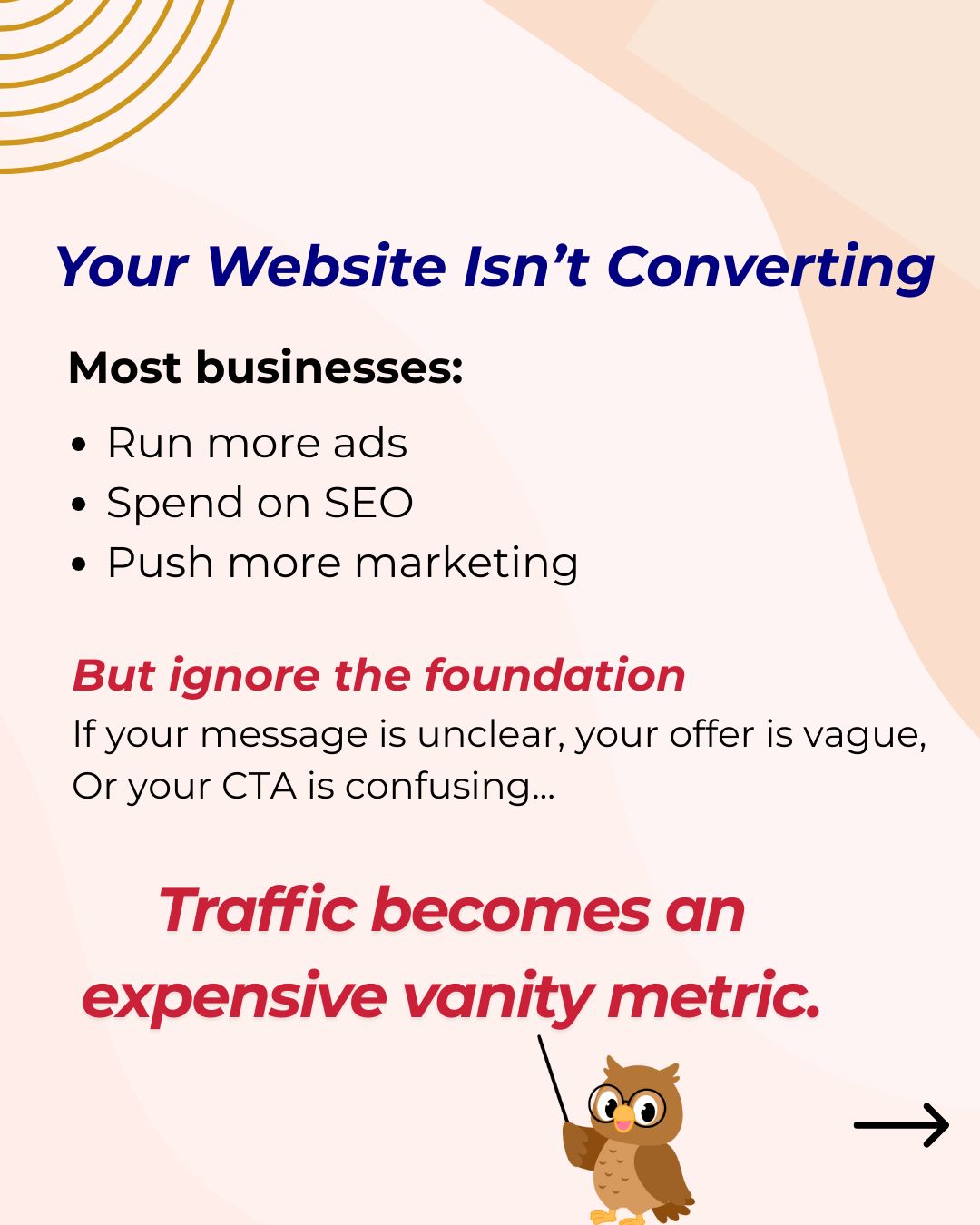
The truth is simple,higher traffic is not going to fix a broken system. Thousands of visitors are not gonna turn into long term customers if your website isn’t harmonized. If your hook is not providing value you are going to immediately lose a customer, similarly unclear messages, vague offers and poor website structure all have the same effect.

This is what most businesses do, instead of fixing their foundation they keep on investing on instant visibility which in turn costs them major opportunities.

Conversion is the true issue, Not Traffic

Businesses need to understand that increased traffic doesn’t actually mean increased revenue. Without conversion, Traffic is just an expensive vanity metric.

Recently more than 30 company websites from different industries were reviewed. Surprisingly, all of them had good traffic ratios but their websites were unable to convert that traffic. Most of those websites had the same fundamental problem. We will be discussing these common problems which entrepreneurs think are not so common in detail.

Most common Conversion killers

Weak and confusing Headlines:

Headline is the first thing people read about your company. Within the first few seconds of the visit the fate is decided by the visitor whether he wants to stay or leave the page. Unclear, excessively generic and vague headlines are going to turn into lost customers. A strong headline should clearly communicate:

  • What the customer needs?
  • How can you help ?
  • Why is it important?

Sometimes you have to help the customer identify the problem and help them solve it, and your headline should make the customer think that they are at the right place. Remember, clarity is more important than creativity when it comes to conversions.

Unclear CTA:

Unclear call to action means lack of clarity in terms of guiding the visitor. If your website’s effectiveness captures the attention of the user, that’s a good start. The real question is does the user know what to do next. If your website is not guiding the user towards an action, whether it is booking a call, signing up or requesting a quote it is creating friction and friction always kills conversions.
If you want your website to have a high conversion rate you have to remove uncertainty. Telling the user what to do next and how to do will make them an easy conversion instead of a wasted opportunity.

Lack of testimonials:

Building trust is the ultimate foundation of doing business and testimonials are the currency of trust in case of online businesses. Without proof of work, the best headlines and CTA’s will fail.

One of the largest gaps found in the industrial research was lack of proof of work and testimonials. When users do not see client success stories on the front page they hesitate to invest in becoming a client themselves which ultimately turns into lost leads.

Some basic additions like:

  • Customer endorsements
  • Reviews
  • Before and After
  • Case studies

Can dramatically increase the trust level of the user which will significantly boost the conversion rates.

Slow loading speed:

In today’s fast paced digital world, speed is the basic necessity of a website. Dead speed websites can make the user leave before they even see your offer. Research shows that even a one sec delay can drastically affect the conversion rates of the website. A well optimized fast paced website not only improves user experience but also boosts engagement and trust.

What happens when you fix basics

The surprising fact is that you can completely change the performance of your website by fixing just the basics, thus there is no need to spend a fortune on massive marketing and a full redesign.

According to the research, companies who invested in improving the basic functionality of their websites saw an average boost of 28% in leads. And this increase came from improving and managing the already existing functionalities, not from bringing new traffic.

Concisely, keeping the base optimised, making impactful first impressions and Keeping CTA clear will ultimately get you massive growth. And businesses mostly get this backwards.They chase traffic and visitors because more traffic feels exciting, it feels like progress but if your conversion rate is not higher than your clicks then you are doing it all wrong.

The right way

Businesses need to understand that growth doesn’t come with traffic alone. It needs alignment, optimization and harmonized core aspects of the website. The three core areas where businesses should work to improve rates are:

Fix your message:

Having a clear and concise message for the user which should include the problem identification, how it is affecting the user and how you can solve it is very crucial. It will make the user understand instantly about what you do and why it matters which will ultimately increase trust. Your message should simply be customer focused.

Fix your offer

A strong offer is the value your business is providing to the customer. Clearly mentioning the strategies applied and tactics used in your work.

Fixing the message is improving your way of communicating your work and offer is the work.

Fix your Funnel

Lastly, fixing the funnel is the integral part of improving the website. As the importance of CTA was explained, your funnel should clearly communicate the user from interest to action. From the landing page to the CTA everything should be concisely clear and easy to understand.

How we help businesses bridge the gap

We think that growth is more about doing the right things in the right order than doing more than what’s needed. Fixing what’s needed, improving the basics and then following a strategy.

We prioritise the digital foundation and needs of the business instead of pushing them into aggressive scaling or rapid advertisements. Because most of the time businesses invest everything but execution of a strategy.

Summary:

Traffic alone does not guarantee conversion and sales at all. Turning a visitor into a high end client does. If the consumers are not directly intended towards a clear CTA, even an extremely aesthetically pleasing website will fail. Clarity and guidance are crucial in this case. An attention grabbing headline, a clear call to action and an experience that naturally encourages the conversations is all that is needed. Without these no matter how much traffic a website gets, potential leads will keep on slipping.

Understanding the user behavior, simplifying the decision making processes for the user and creating a smooth journey from interest to action is very crucial. Users will more comfortably invest in business with clear offers, social proofs and expert positioning. Turning the attention to action should be the ultimate goal.

IT Consultancy Near me

Why IT Consultancy is Essential for Your Business Growth

Introduction

Unlock Your Business Potential

Lets take a moment to reflect on your business’s IT infrastructure. Are you optimizing technology for growth, protecting sensitive data from cyber threats, and staying ahead of the digital curve? If you’re struggling to answer these questions, you’re not alone.

Discover the Power of IT Consultancy

Expert guidance can revolutionize your technology infrastructure, ensuring seamless operations and fuelling innovation. A well-chosen IT consultancy optimizes operations, protects against cyber threats, future-proofs your infrastructure, and unlocks new revenue streams through technology.

Types of IT Consultancy Services

IT consultancy encompasses various services, tailored to suit different groups:

  • IT Strategy Development:

 Ideal for startups, small businesses, and entrepreneurs seeking guidance on technology infrastructure.

  • System Integration and Implementation:

Suitable for medium-sized businesses looking to streamline operations.

  • Cybersecurity and Risk Management:

Essential for large enterprises, e-commerce, and financial institutions requiring robust security.

  • Cloud Computing and Migration:

 Beneficial for businesses seeking scalability and flexibility.

  • Data Analytics and Management:

 Ideal for data-driven organizations seeking insights.

With these services in mind, let’s examine the benefits of partnering with an IT consultancy.

Benefits of IT Consultancy

Partnering with an IT consultancy offers numerous benefits:

  • Expertise:

Access specialized knowledge and skills.

  • Objectivity:

 Gain unbiased perspectives on technology decisions.

  • Efficiency:

 Streamline operations and reduce costs.

  • Innovation:

 Stay ahead of the technology curve.

  • Risk Management:

 Mitigate cybersecurity threats and compliance risks.

To illustrate these benefits, consider the following real-world example.

Real-World Example:

Microsoft partnered with Accenture to implement a cloud-based ERP system, resulting in:

  1. 30% increase in productivity
  2. 25% reduction in costs
  3. Enhanced data security

This success story highlights the tangible results of IT consultancy. Now, let’s explore how local IT consultancy can provide personalized solutions for your business.

Benefits of Local IT Consultancy

Now that we’ve explored the benefits of IT consultancy, let’s dive deeper into the advantages of local IT consultancy.

Local IT consultancy offers targeted solutions, addressing unique regional challenges. By partnering with a local IT consultancy, you’ll enjoy personalized support from experts familiar with your market. This direct access ensures quick issue resolution, minimizing downtime.

Building on this personalized approach, local IT consultancies provide customized solutions tailored to your business needs and local regulations. This targeted approach often proves more cost-effective than partnering with national or international consultancies.

Furthermore, local IT consultancy fosters community involvement, supporting local businesses and economic growth. Regional expertise is another significant advantage, providing an in-depth understanding of local market trends. Enhanced collaboration is further facilitated through face-to-face interactions, ensuring seamless communication.

To illustrate these benefits, consider the following real-world example. Dell partnered with local IT consultancy, Tech Solutions, to enhance their regional operations. Results included a 40% increase in regional sales, 30% reduction in operational costs, and improved customer satisfaction.

With these advantages in mind, let’s move on to selecting the right local IT consultancy for your business.

Choosing the Right IT Consultancy

When selecting an IT consultancy, consider the following crucial factors:

  1. Firstly, assess their expertise and experience in your industry. Ensure they possess the necessary skills to address your specific challenges.
  2. Next, evaluate their reputation and track record. Request case studies, testimonials, and references to gauge their success.
  3. Additionally, consider their scalability and flexibility. Choose a consultancy that can adapt to your growing needs.
  4. Finally, ensure their communication style aligns with yours. Clear communication is crucial for successful project execution.

To further ensure a successful partnership, consider the following essential questions: 

  1. What services do they offer?
  2. What is their experience with similar projects?
  3. How do they approach problem-solving?
  4. What are their availability and response times?

By asking these questions, you’ll gain valuable insights into the consultancy’s capabilities.

For instance, a well-crafted inquiry process helped ABAC Corporation find the ideal consultancy, yielding remarkable results:

  • 99% project success rate
  • 25% reduction in IT costs
  • Enhanced system efficiency

With these guidelines, you’ll find the perfect IT consultancy for your business

Now, let’s move on to implementing IT consultancy services effectively.

Implementing IT Consultancy

After selecting the right IT consultancy, successful implementation is crucial. Ensure a smooth transition by:

  1. Establishing clear objectives and expectations.
  2. Defining project scope and timelines.
  3. Assigning a dedicated project manager.
  4. Fostering open communication channels.
  5. Regularly monitoring progress and addressing concerns.
  6. To guarantee seamless integration, consider the following best practices:
  7. Conduct thorough stakeholder analysis.
  8. Develop comprehensive training programs.
  9. Implement change management strategies.
  10. Establish metrics for measuring success.

By embracing these implementation strategies, you’ll maximize the benefits of IT consultancy.

Real-world applications demonstrate the effectiveness of these strategies. For example:

Microsoft successfully implemented IT consultancy services, resulting in:

  • 30% increase in operational efficiency
  • 25% reduction in costs
  • Enhanced customer satisfaction

Now that we’ve explored implementation, let’s examine the importance of ongoing evaluation and improvement.

Unlocking The Full Potential of IT Consultancy and Implementations Strategies

You’ve found the perfect IT consultancy – now it’s time to bring your vision to life. Effective implementation is crucial to harnessing the full potential of IT consultancy. In this section, we’ll explore the essential steps to ensure a seamless transition.

Step 1: Establish Clear Objectives and Expectations

To establish clear objectives and expectations, define your project goals, key performance indicators (KPIs), and desired outcomes, ensuring alignment with your business strategy.

  • Identify stakeholders and their roles to ensure everyone is on the same page.
  • Determine project scope and timelines to establish a clear direction.
  • Develop a shared understanding of success criteria to measure progress.

Step 2: Define Project Scope and Timelines

  • Outline specific tasks, milestones, and deadlines by creating a detailed project schedule.
  • Establish key milestones and check-in points to track progress.
  • Allocate necessary resources to ensure successful project delivery.

Step 3: Assign a Dedicated Project Manager

  • Appoint a single point of contact to oversee the project, ensuring they have the necessary expertise.
  • Define the project manager’s responsibilities and authority.
  • Establish open communication channels to facilitate collaboration.

Step 4: Foster Open Communication Channels

  • Encourage collaboration and transparency by scheduling regular team meetings.
  • Implement project management tools to streamline communication.
  • Define communication protocols to avoid misunderstandings.

Step 5: Monitor Progress and Address Concerns

  • Track project performance and address issues promptly by establishing regular progress updates.
  • Identify and mitigate potential risks to minimize disruption.
  • Conduct retrospectives for continuous improvement.

Evaluating and improving IT Consultancy

Effective evaluation and improvement of IT consultancy services are crucial for long-term success. Regular assessments ensure alignment with business objectives and identify areas for enhancement.

Key Evaluation Metrics:

To accurately assess IT consultancy performance, consider the following key evaluation metrics:

  • Measure return on investment (ROI) to evaluate financial benefits, as seen in Accenture’s 2020 report, which showed a 25% ROI increase.
  • Track customer satisfaction to gauge service quality, such as Microsoft’s 90% customer satisfaction rate, demonstrating exceptional customer service.
  • Evaluate operational efficiency to identify areas for improvement, like IBM’s 30% reduction in operational costs through process automation.
  • Assess risk management to ensure mitigation strategies, as demonstrated by Deloitte’s 20% reduction in risk exposure through proactive risk assessments.

Step 1: Establish Evaluation Criteria

Define clear evaluation criteria that align with your business objectives to ensure effective assessment.

  1. Identify key performance indicators (KPIs) that accurately measure success, such as revenue growth or customer acquisition.
  2. Develop evaluation tools, such as surveys or assessments, to gather feedback from stakeholders and customers.

Step 2: Conduct Regular Evaluations

Schedule regular evaluations to monitor progress and identify areas for improvement, ensuring timely adjustments.

  1. Gather feedback from stakeholders and customers to understand their perspectives and concerns.
  2. Analyse data to identify trends and areas for enhancement, informing strategic decisions.

Step 3: Implement Improvements

Develop strategies to address identified gaps and weaknesses, ensuring targeted solutions.

  1. Allocate necessary resources for implementation, including budget and personnel.
  2. Monitor progress and adjust strategies as needed to ensure continuous improvement.

Step 4: Continuously Monitor and Refine

Regularly review and refine evaluation criteria to ensure relevance and alignment with business objectives.

  1. Update KPIs to reflect changing business objectives, adapting to shifting priorities.
  2. Ensure ongoing improvement through continuous monitoring and timely adjustments.

Best Practices

Establish a culture of continuous improvement within your organization, fostering innovation.

  • Foster open communication channels to encourage feedback and collaboration.
  • Leverage technology for efficient evaluation and improvement, streamlining processes.

Real-world applications demonstrate the effectiveness of these strategies. For example:

Microsoft implemented regular evaluations, resulting in:

Microsoft increased customer satisfaction by 20% through improved support services.

– The company reduced costs by 15% by optimizing resource allocation.

– Microsoft enhanced operational efficiency through process automation.

SOURCE: MICROSOFT’S 2020 ANNUAL REPORT

IT Consultancy Challenges

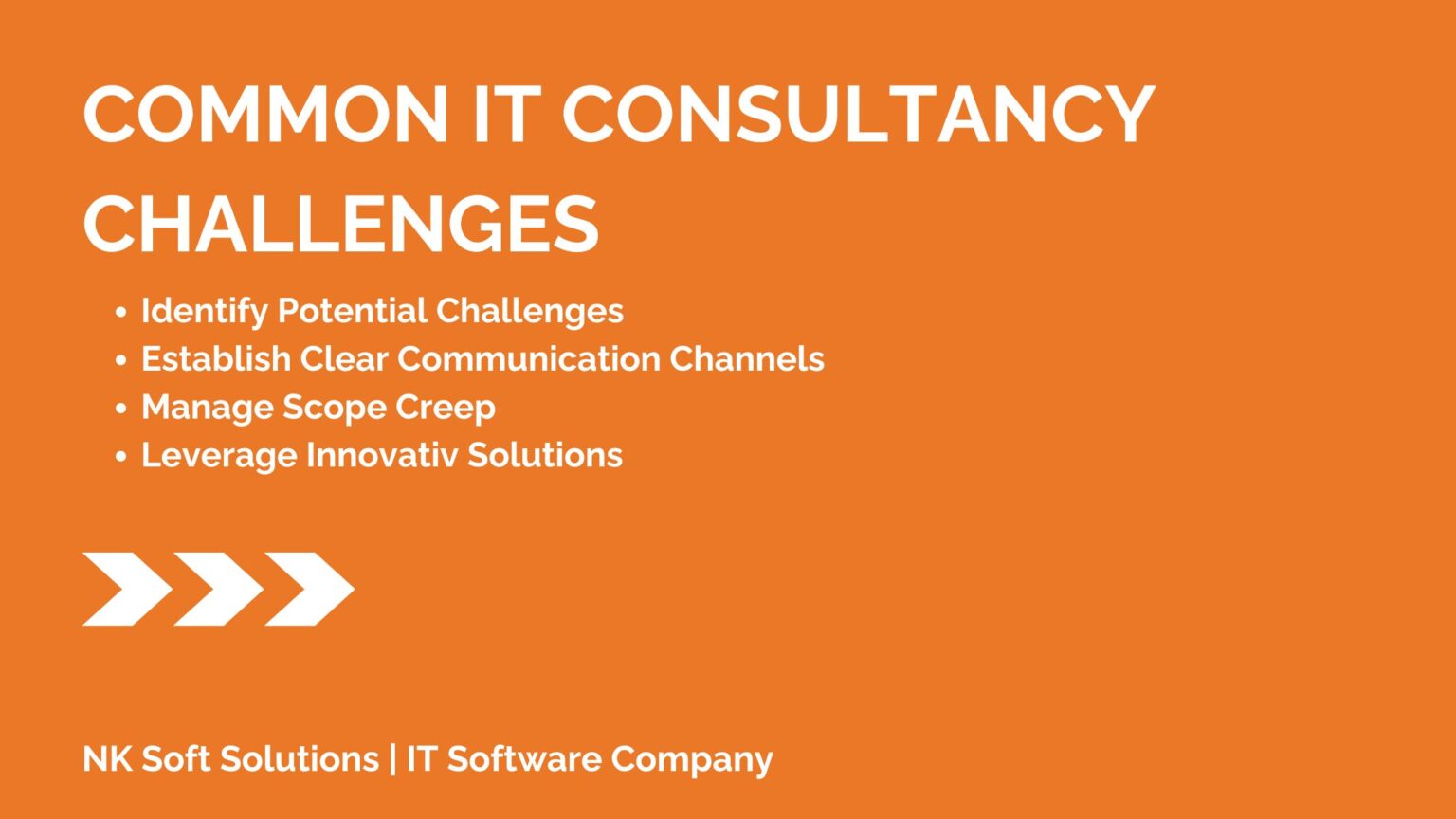
Overcoming Common IT Consultancy Challenges

IT consultancy projects can face various challenges that hinder success. Effective problem-solving strategies ensure timely resolution and minimize impact.

Key Challenges

To overcome common challenges, consider the following:

  1. Address communication breakdowns through clear communication channels and regular check-ins.
  2. Manage scope creep by defining project scope and establishing clear expectations.
  3. Overcome technological obstacles through innovative solutions, such as leveraging cloud computing or automation.
  4. Implement effective change management strategies to mitigate resistance to change.

Steps to Overcome Challenges

Step 1: Identify Potential Challenges

  • Recognize potential risks before they become problems to ensure proactive mitigation.
  • Conduct thorough risk assessments to identify potential challenges.
  • Develop backup plans, or contingency plans, to address unexpected issues.

Step 2: Establish Clear Communication Channels

  • Encourage open and honest communication to foster collaboration.
  • Set up regular check-ins to discuss progress and address concerns.
  • Address conflicts quickly to prevent escalation.

Step 3: Manage Scope Creep

  • Clearly define project scope to prevent misunderstandings.
  • Set realistic expectations to ensure alignment with business objectives.
  • Monitor progress closely to identify potential scope creep.

Step 4: Leverage Innovative Solutions

  • Explore new and creative solutions to address complex challenges.
  • Stay updated on industry trends to ensure relevance.
  • Collaborate with experts to leverage specialized knowledge.
Real-world examples demonstrate the effectiveness of these strategies: Deloitte’s approach to overcoming IT consultancy challenges resulted in:
  • 25% reduction in project timelines
  • 30% increase in customer satisfaction
  • Enhanced collaboration and innovation
SOURCE: DELOITTE’S IT CONSULTANCY REPORT

Measuring IT Consultancy Success

Evaluating IT consultancy success requires effective measurement and evaluation. Key performance indicators (KPIs) and metrics ensure alignment with business objectives.

Common KPIs:

1.Return on Investment (ROI):

Measures the financial return on investment in IT consultancy services.

Example: An IT consultancy project costs $100,000 and results in $150,000 in savings. ROI = ($150,000 – $100,000) / $100,000 = 50%

2.Customer Satisfaction (CSAT):

Measures client satisfaction with IT consultancy services.

Example: A survey of 100 clients yields 90 positive responses. CSAT = 90%

3. Project Timeline Reduction:

Measures the reduction in project timelines.

Example: An IT consultancy project is completed 20% faster than expected. Timeline reduction = 20%

4.Cost Savings:

Measures the reduction in costs.

Example: An IT consultancy project results in $50,000 in cost savings. Cost savings = $50,000

5.Increased Efficiency:

Measures the improvement in operational efficiency.

Example: An IT consultancy project streamlines processes, reducing processing time by 30%. Efficiency improvement = 30%

Steps to Measure Success:

Step 1: Define KPIs

Identify relevant KPIs aligned with business objectives.

Establish clear targets and thresholds.

Example: Define ROI target of 30% and CSAT target of 85%.

Step 2: Collect Data

Gather data through surveys, feedback forms, and project metrics.

Ensure data accuracy and reliability.

Example: Conduct quarterly surveys to measure CSAT.

Step 3: Analyse Data

Assess data to identify trends and areas for improvement.

Compare results to established targets.

Example: Analyse project timeline data to identify areas for reduction.

Step 4: Adjust Strategies

Refine strategies based on data analysis.

Implement changes to optimize performance.

Example: Adjust project management approach to reduce timelines.

Real-world examples demonstrate the effectiveness of these strategies:

Accenture’s measurement approach resulted in:

  • 30% increase in ROI
  • 25% improvement in CSAT
  • 20% reduction in project timelines

SOURCE: ACCENTURE’S IT CONSULTANCY REPORT

Effective Communication

Effective communication ensures all stakeholders are informed and aligned throughout the project. This involves regular stakeholder updates through recurring meetings, progress reports, and newsletters. Clear project documentation is also crucial, maintaining detailed records of project scope, timelines, decisions, and changes. Additionally, establish a transparent issue escalation process to address and resolve issues promptly.

To implement effective communication:

  • Develop a communication plan outlining stakeholder engagement, project updates, and issue resolution processes
  • Assign a dedicated communication lead

Utilize collaboration tools like Slack, Trello, or Asana

Project Management

Strong project management ensures timely delivery and quality outcomes. Define project scope and timelines clearly, outlining objectives, deliverables, and deadlines. Set realistic expectations by establishing achievable milestones and timelines. Embrace agile methodologies for iterative development and flexible responsiveness.

To implement effective project management:

  • Conduct thorough project planning and requirement gathering
  • Establish a project management framework (e.g., Waterfall, Agile, Hybrid)
  • Regularly review and adjust project scope and timelines

Continuous Improvement

Continuous improvement ensures adaptability and growth. Conduct regular assessments of project progress and outcomes. Encourage stakeholder feedback and implement changes. Stay updated on emerging technologies and best practices through industry trend monitoring.

To implement continuous improvement:

  • Schedule regular project retrospectives
  • Implement a feedback mechanism (e.g., surveys, workshops)
  • Attend industry conferences and workshops

Collaboration and Teamwork

Collaboration fosters innovation and success. Assemble cross-functional teams with diverse skill sets. Involve stakeholders in decision-making processes and leverage subject matter expert knowledge.

To implement effective collaboration:

  • Establish clear roles and responsibilities
  • Foster open communication channels
  • Invite subject matter experts to contribute

Risk Management

Proactive risk management ensures resilience. Anticipate potential risks and develop mitigation strategies. Prepare for unexpected events through contingency planning.

To implement effective risk management:

  • Conduct risk assessments
  • Develop a risk management plan
  • Regularly review and update the plan

Technology Expertise

Staying current with technology ensures relevance. Monitor emerging technologies and apply relevant innovations. Maintain a vendor-agnostic approach.

To implement technology expertise:

  • Attend industry conferences
  • Participate in online forums
  • Collaborate with technology experts

Conclusion

Implementing effective IT consultancy services is crucial for businesses to optimize technology infrastructure, drive innovation, and ensure seamless operations. By understanding the types of IT consultancy services, benefits of local consultancy, and best practices for implementation and evaluation, businesses can make informed decisions. Regular assessments, continuous improvement strategies, and effective communication are key to overcoming common challenges and maintaining successful partnerships. By measuring success through key performance indicators, businesses can refine their strategies and achieve significant returns on investment.

In addition to these factors, it is important to consider the evolving landscape of technology and how IT consultancy can help businesses navigate this terrain. With the rapid advancement of digital tools and platforms, organizations must remain agile and adaptable. IT consultants can provide insights into emerging technologies such as artificial intelligence, cloud computing, and cybersecurity measures, allowing businesses to stay competitive.